The traffic was typically heavy on that April afternoon as I drove to the doctor’s office. As her practice, one she shared with one other physician, was some fifteen miles away, I had time to reflect on the recent weeks that had been difficult. Earlier that year, I was down with pneumonia, so the breathlessness and fatigue that continued did not concern me. However, as the weeks began to move into months with the lingering symptoms, I realized something more than pneumonia might well be the culprit. While I drove, my senses took in a balmy, sunny afternoon. People were out walking; children, wearing parochial plaid, were getting out of school. It was simply an ordinary Monday, life as usual.
The waiting room in the house that had been converted into a private practice, was crowded. My doctor had made room to see me that afternoon, so I was not surprised by what would probably be a long wait. It was. I grew a little listless as I checked emails on my cell phone. Eventually, my name was called. My young, female physician greeted me with her usual polite friendliness. I began to describe symptoms.
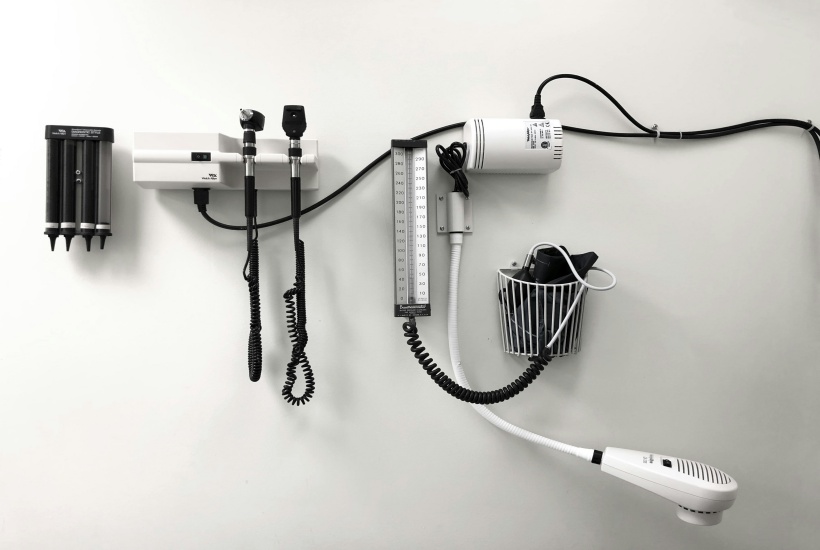
‘You shouldn’t be wheezing at this point.” She frowned slightly and asked me to lie down on the examining table. After listening to my heart and taking my blood pressure, she asked questions about my general energy level and fatigue. I remember her standing in front of me with genuine consternation on her face. I could see the wheels turning in that fine mind of hers. During the year that I had become her patient, she had impressed me. She showed interest in the issues I faced as a minister in a small congregation, and we used to talk freely about several topics. As her practice was an independent one, she was not forced to see 30-40 patients a day; nor did she do data entry into a notebook while her patients talked to a wall, a situation that had become increasingly more common in recent years.
She broke the silence with, “I’m just not comfortable with you leaving today until I know what is going on.” I recall the way she stood, still uncertain as to what she could do for me. She added, “Wait just a moment.”
She returned to the examining room wheeling an EKG machine. Afterwards, she said quietly, “You’re going to the hospital.”
“Uh, okay. I’ll go home and take my dog to the kennel and go right away.” I think my voice shook, as her declaration was the last thing I expected to hear.
‘You don’t understand. I’m calling an ambulance.” She then reassured me that that was the only recourse, and I would be treated competently.
Within minutes, the EMTs were walking into the office and taking my blood pressure. After convincing them to allow me to walk into the ambulance, flanked on both sides by the two men we were on the way to one of the local hospitals.
After hours of tests and a sleepless night in the ER, I eventually found myself in a semi-private room on what I would discover later, was the Telemetry floor. Meanwhile, my accommodating cousin arrived with the assurance that my Cocker Spaniel was taken care of as she had been taken to the kennel.
Eventually, the meticulously groomed cardiologist, entered my room. I remember being self-conscious by my altered status on so many levels: bedhead, crumpled hospital gown, and awkward Holter-monitor that hung down the front of my chest. The man’s sharp appearance was complemented by a silk tie that, of course, matched his shirt, under the inevitable white coat that he wore.
His manner was pleasant and kind. Understandably, he examined my heart. He spoke calmly. “Ms. Stilwell, you have Cardiomyopathy and Congestive Heart
Failure.”
“That can’t be!” I exclaimed, with tears in my voice.
The good doctor sat down next to me and put his arm around my shoulder as I had begun to cry with fear.
Thus began a new life. Those few days in the hospital taught me to be still, to lean into the peace that only God can provide. The five days stay included a heart catheterization that, thankfully, revealed no coronary artery disease. Nevertheless, the extremely low Ejection Fraction of 20% made me a candidate for Cardiac Rehab, not to mention frequent check-ups, and dietary changes. Remarkably, my Ejection Fraction jumped up to 45 % in less than three months. A defibrillator would not be necessary after all.
Meanwhile, I resumed my pastoral duties, lost weight, and began to return to a normal pattern of daily life, with the added cardiac rehab that would remain a part of my
 schedule for some time.
The story that I relate today, occurred eleven years ago. What makes the narrative relevant today?
Getting sick is something no one looks forward to. In our society, we are not exposed to illness the way our ancestors were. While the 19th century American poet, Emily Dickinson was not a part of my family’s tree, the narrative I am about to share is relevant. Dickinson was born in 1830 (Amherst, Mass), and died in 1886. She was 56, late middle-aged by our standards today. The poet was exposed to death regularly, as most people were in the nineteenth century. In fact, Dickinson wrote extensively on the subject. “Because I could not stop for death/He kindly stopped for me/ the Carriage held but just Ourselves/ and Immortality” (Because I Could Not Stop for Death #479).
Dickinson’s girlhood was marked by evangelical fervor (she was a teenager during the 1840s), and her schooling was influenced by the Second Great Awakening, spearheaded by the gifted evangelist, Charles Finney (abolitionist and champion for women’s rights). However, the poet did not share the religious sentiments espoused by the boarding school she attended at the time. These short, four lines of poetry sum up succinctly, the poet’s sentiments: Faith is a fine invention/ when Gentlemen can see/ but microscopes are Prudent/in an emergency. Citation needed here
Clearly, Dickinson’s understanding of faith was limited as her poem undermines its essential character: acceptance of things unseen. The previous sentence could be put better. The reason I include the 19th century writer here is her obvious preoccupation with death. Literary scholars acknowledge freely, the poet’s obsession with the subject. Contrast that to contemporary attitudes toward our inevitable mortality. I could go on here about Botox injections, face lifts, and hair dye, but there is more going on than outward appearances designed to shed a decade or two. Certainly, there is nothing intrinsically wrong about maintaining an attractive appearance. There is, however, something essentially missing in our lives if these things become obsessions. Expressions such as, “Seventy is the new fifty,” strike an odd chord with me, particularly as our youth-oriented-culture tends instead, to treat the 70-year-old as the new 90! Catchy epithets do not change the reality, do they? I digress.
We humans persist in relying on our own abilities to solve the many riddles of our lives instead of going to the source of our gifts in the first place. While Emily
 Dickinson seemed to live in near terror of her eventual demise, she did accept the reality that she would not live forever on this side of eternity. Today, we simply avoid the issue as much as possible by discrediting the elderly by extending our relative youth, however delusional such efforts are.
It seems to me, that the Lord who made us desires far more from his creation than the neurotic behaviors to which I’ve just referred. The Westminster Confession reminds us of the chief end of man: to love God and to enjoy Him forever.
I am not writing a how-to book on discipleship—rather, a collection of illustrations and applications designed to help the reader recognize his/her part in living out faith in belief and action (again, Praxis reflective action). What do our beliefs have to do with the way we live? In a word, EVERYTHING.
I am reminded of the 1970s weekly drama, The Waltons. In one-episode, young John-Boy is describing his dreams to his girlfriend. He shares with the young woman, his perception of people generally. He describes them as sometimes weak and afraid. While the program did occasionally become mired in sappiness, there was much truth in what the program’s main character said. People are afraid; in fact, they are terrified, ultimately, I suspect, of abandonment, oftentimes, in our moments of greatest weakness. We tend to feel the most alone when our lives are in turmoil because those are the moments we tend to feel most out-of-control and vulnerable. The rhythm of our days has been broken, something that creates feelings of imbalance. We have been caught off guard and begin to doubt ourselves, particularly as the ground has been shaken beneath our feet.
When does our faith come in? How do we, in the face of confusion and uncertainty, finally stand (as the hymn writer put it), “on the promises of God”? Let’s look at a few of these promises: “My grace is sufficient for you, for my Power is made Perfect in weakness’ (2 Cor 12:9). Another passage from the apostle Paul is taken from his letter to the Philippians: “I know what it is to be in need, and I know what it is to have Plenty. I have learned the secret of being content in any and every situation, whether well fed or hungry, whether living in plenty or in want. I can do this through him who gives me strength” (Philippians 4:12-13).
Keep in mind that Paul wrote the letter to the Philippians while he was in prison, probably from Rome. The missionary had established a church in Philippi and, even during his struggles, his faith empowered him to pen those words of encouragement. In the case of the former biblical reference, (2 Cor 12:9), the apostle was experiencing his own feelings of vulnerability, yet his faith gave him the strength to encourage the struggling church in Corinth.
What are your struggles today? I described a few of mine earlier. The fact is, as believers, we still have We still live in a flawed world whose initial wonder was marred by the Fall of Adam and Eve, as recorded in Genesis. Initially, we were intended to live forever, which we
will one day. However, as a result of the Fall, we face our mortality here, as temporarily earth-bound creatures. I say, “temporarily” because the Lord has promised a permanent, eternal home for those who believe. “My Father’s house has many rooms; if that were not so, would I have told you that I am going then to place a place for you” (John 14:2). The Lord, in the company of the eleven remaining disciples, was reassuring them of his continued presence in their lives, even as he was preparing them for his departure (arrest, crucifixion, death, and resurrection). Jesus proceeds to talk to the somber group of anxious men, the work of the Holy Spirit. The Greek word: Paraclete means Holy Spirit. The role of the third member of the Trinity was thus inaugurated. The English words: Comforter, Counselor, Advocate are some of the descriptions of the Holy Spirit. As they are translations from the koine Greek, they help us grasp the scope of this member of the Trinity.
 This section might require some explanation for clarification.
As the New Testament was written originally in Greek (with the words of Jesus in
Aramaic), most of us are reading the text in one or more of the many available English translations. While we can draw great meaning from these translations, nothing quite beats the original language. This is true of all literature. Something is lost inevitably in the translation. I used the Greek word, Paraclete, above. In its original language, it contains many nuances (see the former paragraph). However, as we read any one of the English translations, we get only one word/nuance: counselor or comforter, et cetera. As a result, our understanding is limited.
The disciples were probably feeling rather lost on that final evening with their rabbi. They did not grasp fully the message he was giving them. Nevertheless, as a result of the three years spent with their Lord, they had learned and seen love in its purest form. Soon, they would disperse and share the message of Jesus with those with whom they came in contact. Their faith would strengthen; they would become martyrs for the cause of the risen and returning Christ. That first group of followers were not entertainers. They did not make light of the cost of discipleship. Neither should we.
(Bring your concluding thoughts back to the beginning, as your spokes have essentially fallen off the wheel.)