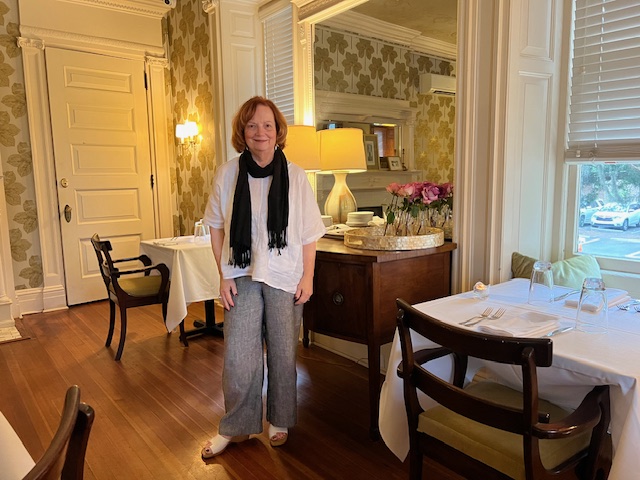
A Little About Me
I was born and raised in Bridgeport, Connecticut. The medium sized industrial city fell into hard times long after I left the area. Sadly, it is seen now as an impoverished drug den. As a girl, however, Bridgeport boasted diners, pizza parlors, and bakeries. The residential neighborhoods were largely divided by the many Catholic churches that dotted the landscape of the ‘50s and ‘60s. The parishes included elementary and secondary schools. Many of my friends attended them. However, my Protestant upbringing relegated me to the public education system. How I longed to be Catholic in those days! The Bridgeport of my childhood and youth was filled with Italian, Irish, and Polish influences which had a positive effect on neighborhood bakeries, not to mention exposure to a variety of different cultures. My brother and I were raised by our devout mother who saw to it that we valued education, music, literature, and the Bible.
My undergraduate years as an English major followed. As I studied the Romantic poets: Wordsworth, Keats, Shelley, and Blake, the wonder and potential of humankind at its best fostered a competitive spirit in me. I dreamed of taking my place among them. (A little arrogant on my part?) Such study also led to an exploration of American transcendentalism, and the American Renaissance, as I moved back to writers from my side of the Pond. This led to the complex poetry of Emily Dickinson. By the time graduate school rolled around, Dickinson’s poetry had me hooked:
I shall know why – when time is over –
And I have ceased to wonder why –
Christ will explain each separate anguish,
In the fair schoolroom of the sky –
He will tell me what Peter promised –
And I – for wonder at his woe –
I shall forget the drop of Anguish
That scalds me now – that scalds me now!
E. Dickinson poem #193
Dickinson’s poetry was filled with, in the words of Richard Wilbur, “sumptuous destitution,” an apt phrase that describes the 19th century American poet as one who did not desire attainment—rather one who chose to continue in her cyclical, no-point-of-encounter system of thought. As mentioned above, the Bible was a central component of the influences provided by my devout mother. As a result, I felt the vacuous nature of Dickinson’s poetry, brilliant though it was. The poet’s citation of Peter, who denied Christ three times, struck me. Clearly, Dickinson scorned the possibility of encounter with the Godhead. I, on the other hand, desired encounter! Within four years of completing an English graduate degree, I found myself enrolled in a Master of Divinity program. What followed were years in pastoral ministry along with adjunct teaching. Theology and literature were powerful bedfellows, and I absorbed both eagerly.
Today, years later, I am a happily married retiree, living in the midst of the fragrant forests of Tennessee, a place my husband and I made home twelve years ago. At last, I have become a blogger, an interpreter of life as I see it in this complex world. Our dear miniature Schnauzers, Ernie and Eliot (named after Ernest Hemingway and T.S. Eliot), bring joy and laughter into our lives.