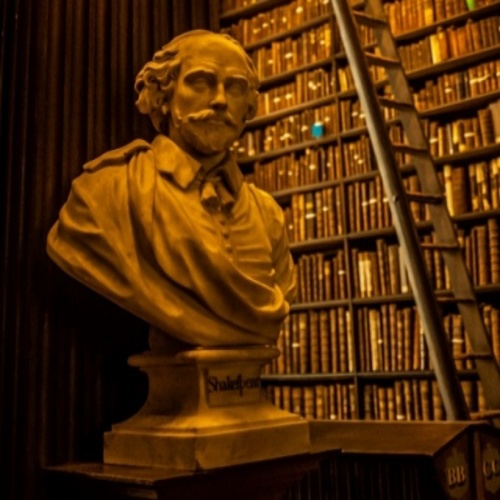
He was a tall man, in possession of very long legs. Bill Fry was a popular professor in the English Department of the small, Christian liberal arts college with its view of the striking Hudson River. The campus stood well above the river; I recall many moonlit nights with its reflection on the water, a view within our vision as students, a quality described with enthusiasm and esthetic appreciation. What a pretty place it was and how we students reveled in it! Back to our tall, if not rather gangly professor. After all these years, I can still see Dr. Fry roaming up and down the aisles of desks as he read a soliloquy from Hamlet or Othello. The man’s passion for the 16th Century Bard was palpable. The students were generally spellbound by their charismatic professor. I, however, was not. While a Shakespeare enthusiast, I found the professor an intimidating presence. I recall the many multiple choice tests Dr. Fry administered when I was eager to describe my impressions of key characters that the playwright brought to life through his incomparable use of language. However, that was not the professor’s testing style, so I committed the unpardonable sin as an English major: I received a C in the course on Shakespeare. As I had been an enthusiast of the 15th century poet since the 8th grade, that was an unexpected result. I kept whatever gifts were in my possession sufficiently hidden as to call into question their existence. So, we were reciprocally unimpressed with each other.
Those were the undergraduate years I assumed would never end somehow and opportunities for achievement would simply come, with little effort on my part. What a rude awakening when that proves not to be the case!
Despite the ebb and flow of mediocrity and achievement, my years at Nyack managed to offer a few rewards. One of them came in an unexpected form. A year or more had passed since the unexceptional Shakespeare course when I found myself faced with Dr. Fry again, who, by this time had become the chair of the English Department. Well, I had become a Senior and was enrolled in the required English Seminar. The form of the class was an intensive, weekly, three-hour session that featured various historical periods of literary study: 18th Century English Literature; 19th Century Victorian Literature, etc. I had found Victorian Literature rich in both quantity and quality and chose that period on which to focus my
 attention (students were required to select a period and present their research in front of the entire English Department faculty).
There were about 12 students enrolled, so there was an intimacy that encouraged a lively exchange of ideas and observations that revolved around the various poets, novelists, and essayists whose works were under our rather unsophisticated scrutiny. After all, none of us had taken a course quite like this one before. We were all a little intimidated at the charge we had been given to provide trenchant analyses of writers’ works that had more than stood the test of time. At any rate, students began to arrange themselves in pairs and make their respective choices. However, I requested that I work solo on the Victorian Period. As no one else expressed an interest in that period, I was free to work on the project alone. I was delighted with the sense of freedom that I felt.
Some two months or so into the semester, the week finally arrived for me to present my research. I had books, articles, charts, photographs, and the white board to serve as visual aids. (Obviously, PowerPoint was still decades away; no such technology existed at the time.) My presentation took more than two hours; we did allow for a 20-minute break to divide the time manageably and to permit people to get coffee if desired. I remember vividly the enthusiastic responses from both fellow students and faculty. At the end of the class, Dr. Fry wanted to talk to me about my work. He was not only supportive and visibly impressed, but he was also clearly surprised. He indicated that I waxed quite professorial and had not realized the amount of knowledge that I possessed about the period under study. Finally, the established academic asked me to promise him that I would go on to graduate school. Given my far from stellar performance in his Shakespeare course, that final compliment surprised me. He added that he, too, had had his period of underachievement as he continued to encourage me to move ahead academically. I was impressed by his frankness about his own past. His observations were thoughtful and kind. I think we both realized how little we had known about each other and expressed gratitude for that period of honest disclosure.
That special afternoon took place 48 years ago. The good professor died of cancer in 2009, after decades of impact on students’ lives. Mine was one of them.