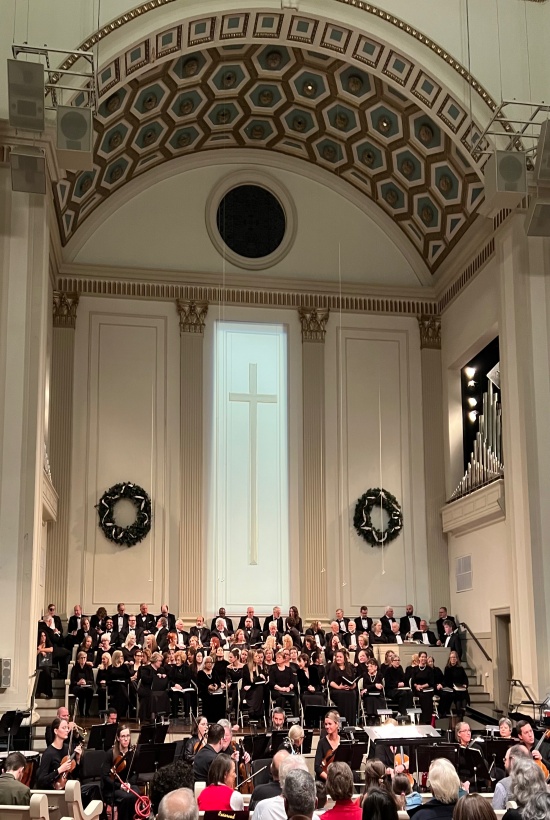
The sanctuary was hushed with expectancy. The lights were low; a tall Christmas tree stood in the shadows. The orchestra began the moving overture of Handel’s Messiah. The choir stood at the conductor’s direction. Well into the oratorio, a small, pretty woman stepped out from the choir and readied herself to sing, I Know That My Redeemer Liveth. The clear, soprano voice filled the reverent space.
The singer that night, nearly 50 years ago, was my mother. She died 20 years ago and, I suspect is now singing with the angels. I remember the joy of that evening. My brother, sister-in-law, and I were in attendance and in years to come, would reminisce about that night.
Another memory bears mention here. Some 35 years ago, my mother and I had spent an afternoon together; she lived about 50 miles away from the pretty small town in which I lived at the time, in Rockland County, New York. We had shared a meal in one of the many restaurants the area offered. After our lunch, my mother drove along several streets, then pulled into a random parking lot. The two of us just began to talk. Thoughts poured out of her as she shared goals she and my father had years before. I saw my mother in a new light as she described her disappointments in the dreams that had never materialized. My divorced parents had parted decades earlier and the pastor/ missionary team never happened. Obviously, as I grew up in that fragmented household, I was aware of many of the facts my mother talked about that day. What moved me were the unexpressed thoughts implied by what she did say. I saw before me, a person of many unused gifts. That reality brought tears to my eyes. I suspected the Lord would have worked mightily in the disappointed, middle-aged woman who sat in front of the steering wheel of the small car her modest salary could afford. Later, my mother would return to her rented space where she lived alone.
How many people have similar stories to share? I am not dehumanizing my mother here—rather, suggesting that many people end up disappointed with their lives. Perhaps some of that disappointment comes from a strong sense of waste. We are a society of spectators. This is not what God called any of us to be.
While my dear mother taught my brother and me about Jesus, filled our apartments with music and ideals, her own never came to fruition.
How many nightingales are reading this right now? I use the term metaphorically. Is there a song you never got to sing? Paul’s words in his letter to the Philippians, come to mind now: “Beloved, I do not consider that I have made it my own, but this one thing I do: forgetting what lies behind and straining forward to what lies ahead, I press on toward the goal for the prize of the heavenly call of God in Christ Jesus.” (Philippians 3:13-14, The New Oxford Annotated Bible — NRSV).
The first century apostle uses an athletic image to express himself here. The allusion makes me think of the runner, forging ahead, hoping for victory as (s)he wins the race. To what does the pronoun “it” refer (verse 13)? Earlier, in that chapter, the missionary shares his desire to be found in Christ, and if that includes the apostle’s own demise, then Paul’s wish is a powerfully expressed one. “I want to know Christ and the power of his resurrection and the sharing of his sufferings by becoming like him in his death” (Ibid, v 10).
Keep in mind that Paul was in prison when he wrote these words; he was also chained to a Roman guard. Yet, the short letter to the people in Philippi, is filled with hope and joy. Clearly, Paul the prisoner did not allow his grim circumstances dictate his state of mind.
As we age, our memories increase and our dreams decrease, simply because our time on the planet is shortened. As a result, we reflect on what we’ve accomplished and on what we have not. On one level, this attitude makes sense: it’s basic arithmetic. We have more years behind us than the number of years ahead. What we’re not considering when we make such a conclusion, is that God is outside of time. He views us in the eternal scheme of things. Would that we could. Nevertheless, the amount of time we have left is not the point. Sadly, if my gifted mother had realized that her remaining years would have told a different story.
Jesus entered human history for a very short time, roughly 33 years. We know  nothing of his childhood, and just a little about his adolescence; the narrative of Jesus’ meeting at the Temple when the 12-year-old displayed a remarkable amount of knowledge and wisdom. Meanwhile, Mary and Joseph had spent hours agonizing over their missing young son. The final three years of the Master Teacher’s life is recorded in all four Gospels in the New Testament. Three years!! The world was changed as a result of those scant years.
The record of history is filled with stories of people whose biographies focus on short periods of time because the writers desire to emphasize the accomplishments of their subjects. What is often the case, is the relative short periods many of these individuals made their respective marks on society.
I think there’s a lesson here. God’s time is not the same as ours. Granted, believers generally recognize that, but sadly do little with their own lives as they see finite, linear time as the great enemy. They believe they have too little left, whether they are 30 or 60. What an unfortunate conclusion.
I am impressed by the Dutch watchmaker, Corrie Ten Boom. Obviously, I am not alone, as many people have written about her story. The Billy Graham Evangelistic Association produced a film called The Hiding Place (1975), that played in theaters throughout the world and moved many. I don’t need to repeat it here. However, one element bears recognition: the fact that the plain, single, older woman was given the world for her stage. Ten Boom was in her 60s and 70s when she traveled from country-to-country and told her story of the horrors she and her sister Betsie endured at Ravensbruck. Betsie’s already weakened heart gave out; she died and entered the presence of the Lord. Corrie went on to share her story of faith, tried as it was in that often-referenced concentration camp.
How many Americans are obsessed with the lives of the rich and famous: the glamor, the opulence? Yet how many of these “stars” have impressed anyone on the level that Corrie Ten Boom from Haarlem, Holland did? As I mentioned earlier, God did not create humankind to be mere watchers of a selected portion of society. He, in other words, did not create people to live in the passive voice. So, why do we?
Sometimes, our circumstances hold us back, particularly those from our respective childhoods. Those early years set the stage for good and for bad. My dear mother was born into an impoverished family, just three years before this country was plunged into The Great Depression. She experienced all manner of privation: literal starvation, and sometimes a lack of electricity, due to bills that could not be paid by her widowed, overwhelmed mother. In such an atmosphere of poverty, the little girl grew up with a lack of self-worth that would affect her for the rest of her life. Yet, my mother did not raise my brother and me to be spectators. She introduced us to the Bible and to books generally.
I think my mother’s life in the shadows had much to do with the undiagnosed depression that her early years had set in place. As a result, our home, while touched by faith and music, had a pervasive emptiness that clung to our lives like the fog in an  early morning. Perhaps the lack of self-worth is rooted in much of our lives; some are drawn to shallow media outlets to escape, and others become withdrawn and lonely.
I think what I’m trying to say is that what we do now is what matters most. Just as Paul addressed his past by pointing out the importance of looking ahead, so should we. How do we become change agents in our congregations (clergy and laity alike)? Such change begins internally, within the individual’s heart. Jeff Benner addresses the Hebrew concept of the human heart. “To the ancient Hebrews the heart was the mind, the thoughts. When we an told to love Elohim with all our heart (Deut. 6:5), it is not speaking of an emotional love, but to keep our minds and our thoughts working for him ” (Jeff Benner, citing Strong’s definition of “Heart”). Check out Strong’s definition of heart.